AIDA
AIDA
Enterprise Bot
Enterprise Conversational AI Platform
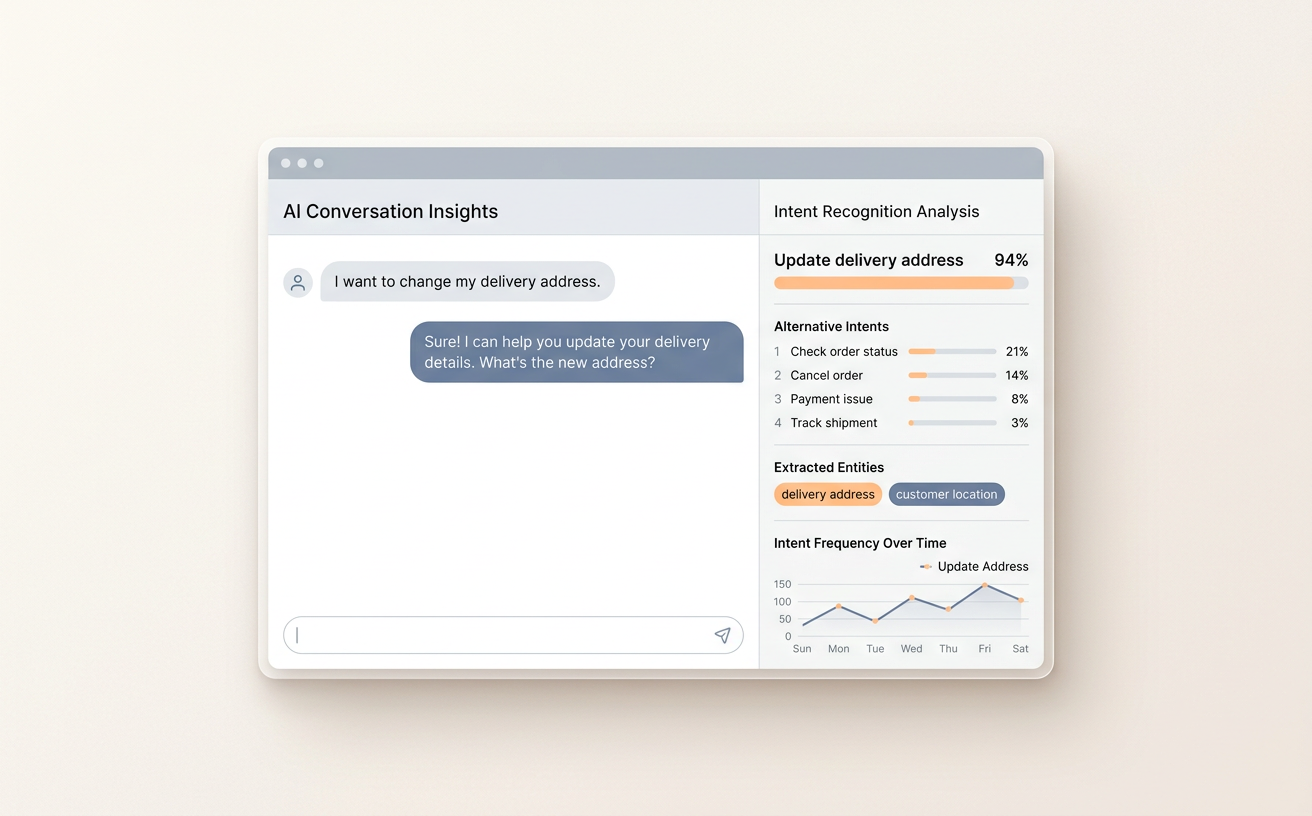
Designing a scalable enterprise conversational AI experience.
Enterprise Bot
Enterprise Conversational AI Platform
Designing a scalable enterprise conversational AI experience.
AIDA is an enterprise conversational AI platform that enables businesses to build, train, deploy, and manage AI-powered bots across customer service channels. From deterministic conversation flows and knowledge retrieval to human-agent escalation and performance analytics, AIDA brings the tools needed to manage the conversational AI lifecycle into one platform.
The challenge lies not just in designing individual features, but in making an extensive ecosystem of interconnected capabilities understandable, configurable, and usable for enterprise teams.
AIDA supports this broader operational lifecycle through interconnected capabilities.
Create deterministic bots using intents and entities, configure conversational behaviour, and incorporate RAG to retrieve relevant information from connected knowledge sources.
Train conversations, improve bot responses, and manage knowledge bases with role-based access control (RBAC), enabling appropriate users to maintain and govern content.
Connect bots to websites, applications, and Genesys environments, allowing businesses to bring conversational experiences into their existing customer service ecosystem.
Extend automated conversations into LiveChat, where agents can handle escalations, receive transferred conversations, and use agent-assist capabilities during customer interactions.
Use analytics to monitor bot performance, agent productivity, conversation outcomes, and industry-standard contact centre KPIs.
When these capabilities evolve independently, the experience can become difficult to navigate and maintain.
The key UX challenge is to make the platform feel like one coherent product rather than a collection of individual features.
The design opportunity is to organise complexity around user goals, clear relationships between capabilities, and predictable workflows.
Structure the experience around the stages of building, training, deploying, operating, and improving a bot. Help users understand where they are and what they need to do next.
Expose essential actions first while retaining access to advanced configuration for users who need greater control. Avoid forcing every user to understand the full system before completing a task.
Clarify the relationships between intents, entities, knowledge sources, integrations, and deployment. Help users understand how configuration decisions affect downstream behaviour.
Make permissions, ownership, and access boundaries understandable. Users should be able to identify what they can manage and where administrative approval may be required.
Treat escalation and agent handover as deliberate parts of the conversational journey, not as isolated features added after the chatbot experience.
Present performance metrics in context, helping different users identify issues, understand trends, and decide what to improve.
Configure intents, entities, conversation logic, and RAG.
Refine conversations and maintain the knowledge base.
Connect the bot to websites, applications, and Genesys.
Handle automated conversations, escalate to LiveChat, transfer agents, and use agent assist.
Analyse performance and contact centre KPIs to identify opportunities for refinement.
The experience must also account for the relationships between these stages. For example, a knowledge base update may affect bot responses, deployment changes may affect the customer experience, and analytics may reveal where conversational training needs improvement.
| User group | Primary goal | UX consideration |
|---|---|---|
| Bot builders | Configure and refine conversational behaviour | Clear configuration, validation, and feedback |
| Knowledge managers | Maintain reliable knowledge sources | Accessible content management and RBAC |
| Administrators | Manage access and integrations | Clear permissions and system status |
| Contact centre agents | Resolve customer conversations | Efficient handover and agent-assist workflows |
| Team leaders and analysts | Monitor operational performance | Readable KPIs and actionable reporting |
The design needs to support these distinct goals while preserving consistency across the platform.
Outlined: automated · Filled: human-supported
This introduces a different set of experience requirements. Customers need a coherent transition from bot to agent, while agents need sufficient context to continue the interaction without unnecessary repetition.
The broader product challenge is to design AI and human support as connected parts of one service experience.
The UX challenge is to present a comprehensive set of industry-standard KPIs in a way that helps users move from monitoring to understanding and action.
A useful analytics experience should distinguish between high-level performance summaries, detailed breakdowns, and areas requiring attention. Where supported by the product, users should be able to explore results by channel, team, agent, intent, or other relevant dimensions.
High-level performance at a glance.
Explore by channel, team, agent, or intent.
Surface the areas that need action.
The ultimate goal is to connect operational insights with opportunities to improve bot behaviour, agent workflows, and customer outcomes.
The work involves understanding complex workflows, identifying relationships between features, and collaborating with product and engineering teams to translate requirements into usable product experiences.
AIDA illustrates a central challenge in enterprise AI design: the more capabilities a platform offers, the more important it becomes to establish a clear and consistent experience across them.
The product connects bot creation, training, knowledge governance, integrations, human-agent operations, and analytics. Its long-term usability depends on how effectively these capabilities work together.
The challenge of enterprise AI is not simply making the technology work. It is making the complexity behind it understandable, manageable, and useful to the people who depend on it.
AIDA provides a lens through which to explore that challenge across the full conversational AI lifecycle.
How the product is structured — the top-level areas and what lives inside each.
Low-fidelity layouts for the key screens, focused on structure and hierarchy before visual design.